Abdabra
Stop metastasis early
Preamble
Many of you may know someone who has prostate cancer, or perhaps you do. Perhaps a friend or loved one died of the disease. While much progress has been made on prostate cancer therapies, there remain gaps.
Notably, many people are initially diagnosed as nonmetastatic. For a while they are fine. But over a period of years, the disease slowly progresses, often invisibly. Cells spread around the body, and finally metastasis becomes visible, at which point it is nearly impossible to reverse course.
We set out to solve this problem at the beginning. Here we tell the story of how we will do this.
Background
Sometimes, metastasis is invisible. Prostate cancer is localized if it cannot be seen (outside the prostate) by the most sensitive imaging technology, PET-CT/PSMA, which can see a 2.3 mm tumor (3 million cells) about 50% of the time.
Metastasis is happening even if it is invisible!
Prostate cancer risk is assessed based on biopsy and MRI.
The number of high risk localized prostate cancer diagnoses per year is about
Our mission
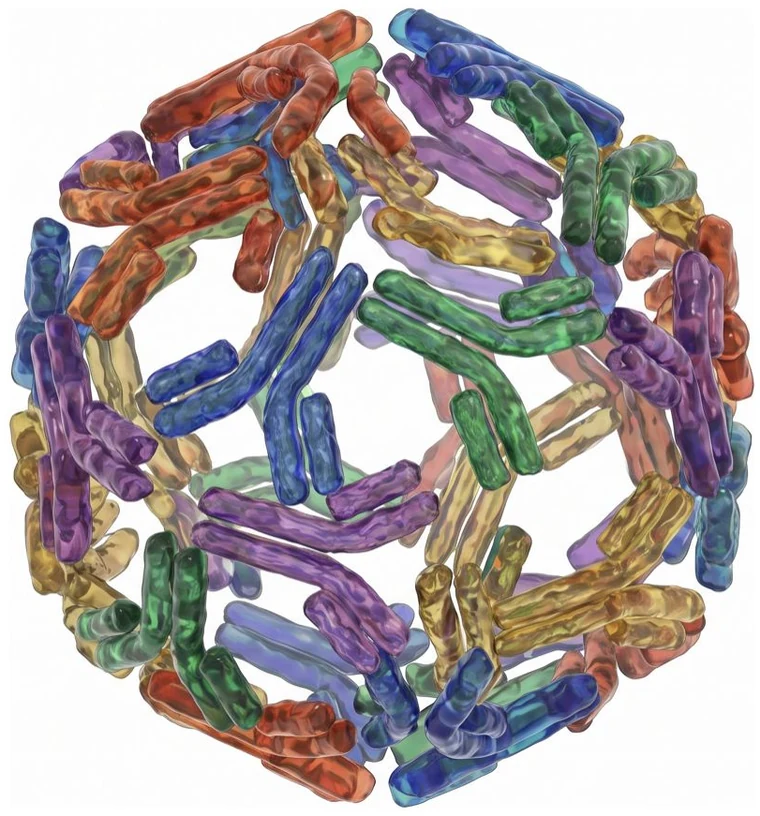
Develop an antibody drug to treat high risk localized prostate cancer by killing isolated prostate cancer cells.
This makes sense because isolated cancer cells are relatively unprotected, unlike tumors. However we do have to kill small clusters, which migrate in our bodies along with single cancer cells.

Our antibody will actually be a cocktail: more than one antibody, because the starting prostate cancer, usually adenocarcinoma, often changes over time into other more dangerous types, including neuroendocrine prostate cancer. We should target such at the start to hinder their proliferation. One protein target is unlikely to suffice to target all species.
No other company is in this space (to our knowledge).
Cell killing is a thing
Existing drugs do it for other cells for other diseases. Obinutuzumab kills B cells, for chronic lymphocytic leukemia (annual sales $1.2B). Benralizumab kills eosinophils and basophils, for eosinophilic asthma (annual sales $2.0B). These drugs have very similar design to our drug.
Treatment course
For the experts
Our antibodies will be Fc enhanced for effector function and half life, will not carry payloads, and will not be T cell engagers. They are intended for long term use. The antibody targets we choose will all be highly specific.
How will we make money?
We are an “internal platform” company. That is, we will build tools that allow us to find our drug. We will not sell these tools. The tools will allow us to assess potential targets and antibodies to them in parallel at high throughput. Once we have our drug, we will take it through clinical trials, then sell the drug to a large pharmaceutical company – which can do the things that we as a small company cannot.
Abdabra
We are a very early stage (pre-seed) company. Currently we are talking to the prostate cancer community (and anyone else who is interested). If you’re curious, we’d love to hear from you — write to us: info@abdabra.com.
A word about our founding team



David Jaffe is a mathematician turned computational biologist turned antibody developer. Most recently he was a cofounder of Infinimmune, which develops antibody drugs targeted at inflammatory disease. Before that he was Computational Biology Fellow at 10x Genomics; his last project there was to redesign their 10x VDJ platform to do clonotyping correctly; he also built a tool enclone for looking at VDJ data. Before that he was Director of Computational Research and Development in the Genome Sequencing and Analysis Program at the Broad Institute. The work of his group included the development of ARACHNE, ALLPATHS and DISCOVAR. Before that he was Professor of Mathematics at the University of Nebraska – Lincoln, where he worked on algebraic geometry and then error correcting codes. He received his PhD in Mathematics from the University of California – Berkeley. Here are his publications. He entertains himself by running trails with a camera.
photos courtesy DJ
We are still recruiting founders.